LDPE granules, reprocessed material and scrap
We buy granules for a living, so this page is written from the buying side. What the grades mean, what moves the price, and the honest picture on reprocessed material: where it is a smart saving and where it is a false economy.
Talk to us about material →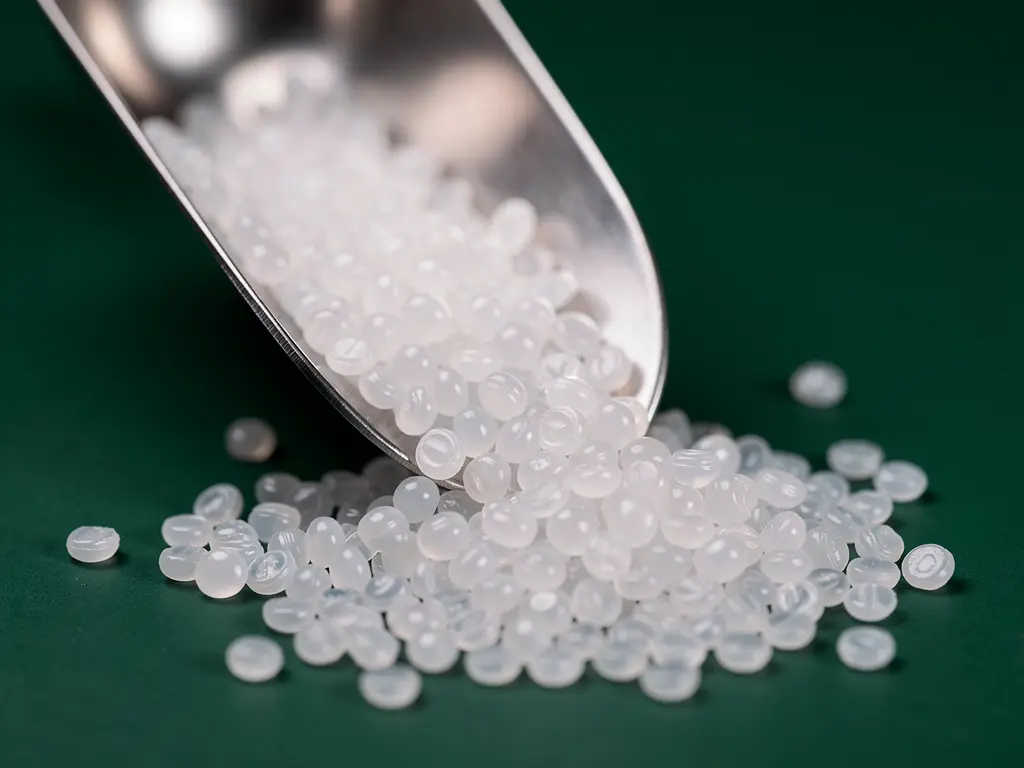
How LDPE granules are graded
A granule spec sheet has dozens of numbers on it. Three of them decide what the material can do.
1. Melt flow index (MFI)
How easily the molten polymer flows, measured in grams per 10 minutes. Low MFI means a thick, viscous melt: harder to push through a die, but stronger film. High MFI flows easily and suits injection moulding rather than film. Film grades sit in a narrow band, and a converter switching MFI has to retune the whole line, which is why we do not casually substitute grades on your job.
2. Density
Between 0.910 and 0.925 g/cm³ for LDPE. Within that range, higher density means slightly stiffer, slightly stronger, slightly less clear film.
3. Additive package
Slip and anti-block additives so film does not stick to itself, antioxidants so it survives extrusion, UV stabilisers for outdoor life, antistatic agents for electronics and powders. Additives are where a lot of the practical performance lives, and they are also where cheap material cuts corners invisibly.
Virgin versus reprocessed: the honest comparison
Reprocessed material is not a lesser product, it is a different one with a legitimate place. What is not legitimate is quoting virgin and delivering a blend. We state the blend on the invoice for exactly this reason.
What actually moves granule prices
If you buy LDPE products regularly, these are the four things behind every price revision you receive:
- Crude oil and naphtha. Ethylene comes from petroleum feedstock. When crude moves sustainably, polymer follows within weeks.
- The rupee against the dollar. A meaningful share of Indian polymer supply is imported or dollar-indexed. A weaker rupee raises granule prices without anything else changing.
- Domestic plant availability. A large Indian cracker going into maintenance tightens supply regionally and lifts prices for a quarter.
- Season and demand. Agricultural film before planting, packaging before festivals. Predictable, and it shows up in lead times before it shows up in prices.
This is why we do not publish a rate card and why quotes carry a validity window. A converter who promises a flat price for twelve months is either hedging on a scale we cannot see or planning to recover it elsewhere, usually in micron. See the price guide.
LDPE scrap: what happens to it
LDPE scrap is a real commodity with a real market, and the grading is simpler than people expect. It comes down to three questions: how clean is it, is it sorted by colour, and is it one polymer or a mixture.
- Clean, natural, single-source film (factory offcuts, unprinted liners) is the top grade. It can be washed, shredded, pelletised and returned to near-usable film-grade material.
- Printed and mixed-colour film is worth less. Ink and mixed pigments mean the reprocessed pellet has an uncontrollable grey-brown base tint.
- Contaminated film (food residue, agricultural soil, mixed polymer) is the hardest problem. Farm mulch film is the classic case: technically recyclable, practically full of soil and moisture that makes reprocessing uneconomic.
We are a converter, not a recycler or a scrap trader. Our own production offcuts go back into non-food work or out to reprocessors. If you have volume scrap to move, the buyers you want are film-specific aggregators, not general kabadi channels, because sorting is where the value is. More context in LDPE recycling.
Keep reading
Granule and scrap questions
We convert granules, we do not trade them
If you need finished bags, film, sheet or covers, we are your supplier. If you are looking to buy granules or sell scrap, we are not a trader, but tell us what you have and we will point you at the right kind of buyer.