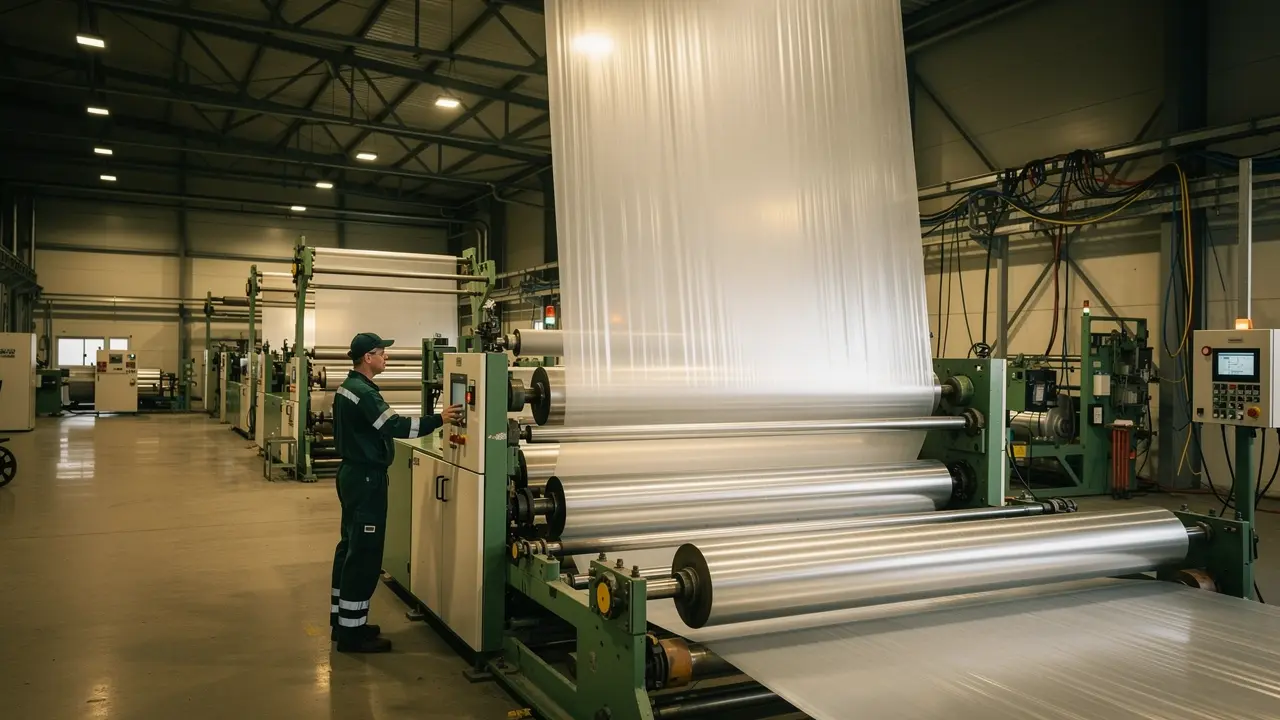
Knowing how blown film is actually made changes how you buy it. Every quality issue and every price lever in LDPE traces back to one of the stages below, so this is worth ten minutes if you buy plastic packaging regularly.
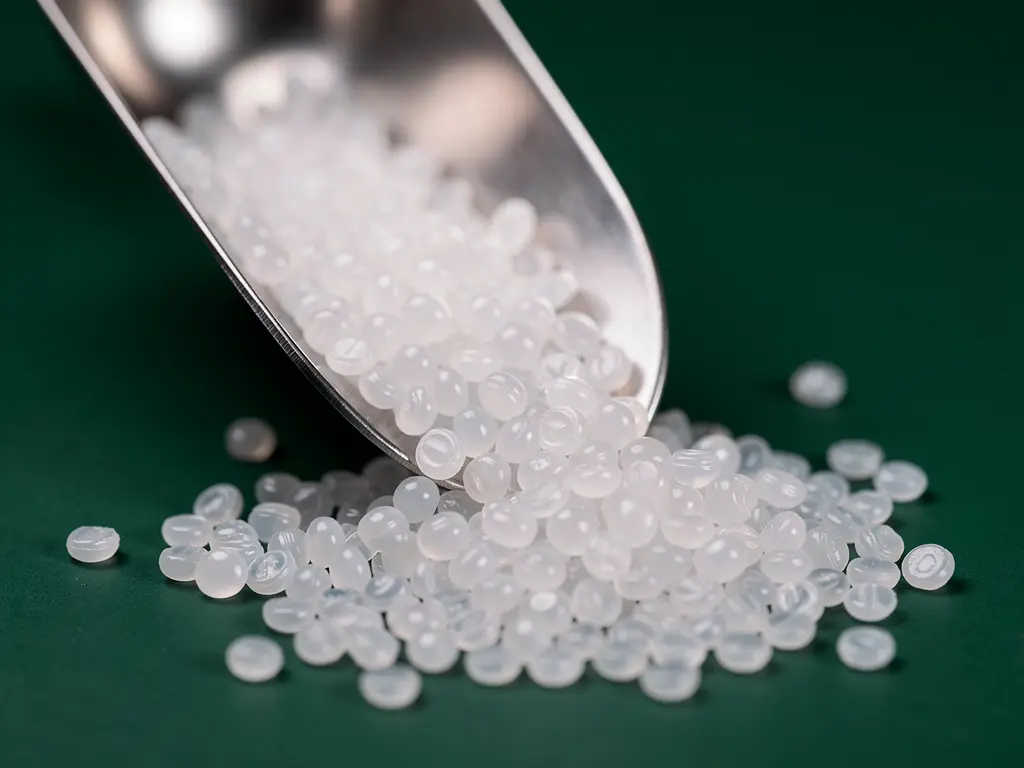
LDPE granules, sometimes blended with LLDPE for tear strength, plus masterbatch for colour, UV protection, slip or antistatic properties. This is where the properties of your finished bag are actually decided. A cheaper resin blend shows up three weeks later as a bag that splits.
02
Blown film extrusion
Granules are melted around 160 to 200 degrees Celsius and forced through a circular die. Air is blown up the middle to inflate a bubble, which is cooled by an air ring and drawn upward. The ratio between the bubble diameter and the die (the blow-up ratio) and the take-off speed together set the thickness. This one stage decides gauge, gauge consistency, clarity and strength.
03
Treating and winding
The cooled bubble is collapsed into a lay-flat tube and wound. Corona treatment is applied here if the film will be printed or laminated, because ink will not hold on untreated polyethylene. Winding tension matters more than people expect: wind too loose and rolls telescope, too tight and the film blocks.
04
Flexo printing
Up to 4 colours from photopolymer plates. Each colour is a plate, a station and a register check, which is why colours cost money and why print has an MOQ. Food-grade work is printed on the non-contact surface with food-safe inks, always.
05
Converting: cutting, sealing, punching
The lay-flat tube becomes a product here. Bottom-seal or side-seal bags, gussets folded, drainage or vent holes punched, handles cut, self-adhesive flaps applied, liners cut to drum dimensions, rolls slit to width. Sealing temperature and dwell time are the variables that decide whether a seal holds under load.
06
QC, packing and dispatch
Gauge, dimensions, seal strength and print register checked against the job card. Bales or cartons labelled with product, size, micron, lot and date. Then out the gate to your city. Full detail on quality and specs.
STAGE ZERO
Everything is decided by what goes in the hopper
LDPE granule is not one material. Grades differ in melt flow index, density and additive package, and a converter chooses between them on price and behaviour. That choice is invisible on a finished bag and obvious in how it performs.
This is why we name the blend on your quote. Virgin LDPE, an LDPE-LLDPE blend, or a recycled-content blend for non-contact work: three different prices and three different products. What we will not do is quote you one and run the other.
It is also why food-grade orders start with a purge. The previous job left colour and material in the machine, and nobody wants last week's black masterbatch in this week's bread bags.
Two things about blown film worth knowing as a buyer
Gauge is a running average, not a constant
Film comes off a circular die and gets cooled by moving air. Small variations in either show up as thickness variation around the bubble. A good line holds that variation tight. A tired line with a dirty die does not, and the film that results is technically the right micron on average while behaving unpredictably in your machine. This is the single most common cause of "the film is fine but our seals keep failing".
Wider is not always better
Every line has a comfortable width range set by its die and air ring. Pushing a line to its extreme edge to hit an unusual width gives you worse gauge control than running a standard width and slitting it. If you ask us for a width that sits badly on our lines, we will tell you and suggest the nearest one that runs well, because a slightly different width you can rely on beats an exact width you cannot.
Our capability, plainly
30 to 400
Micron range across bags, film, sheet, covers and grow bags.
8 ft
Maximum lay-flat width, which opens to roughly 16 ft as a single sheet.
4
Flexo print colours, register-controlled for repeat-length machines.
1 day
Quote turnaround. Lead time is typically 7 to 15 days depending on print and volume.
Come and see it, or send a sample instead
Buyers within driving distance of Chennai are welcome at the factory on ECR. If that is not practical, send a sample of what you currently buy and we will tell you exactly what it is made of.
No call centre in the middle. Send a spec and it goes to the factory desk at Kovalam, where the person replying can see whether the line is free next week.