What is LDPE? A manufacturer's explanation
LDPE is the plastic in your bread bag, your squeeze bottle, the sheet on a building site and the liner in a chemical drum. Here is what it actually is, why it behaves the way it does, and what that means when you are buying it.
Talk to us about a spec →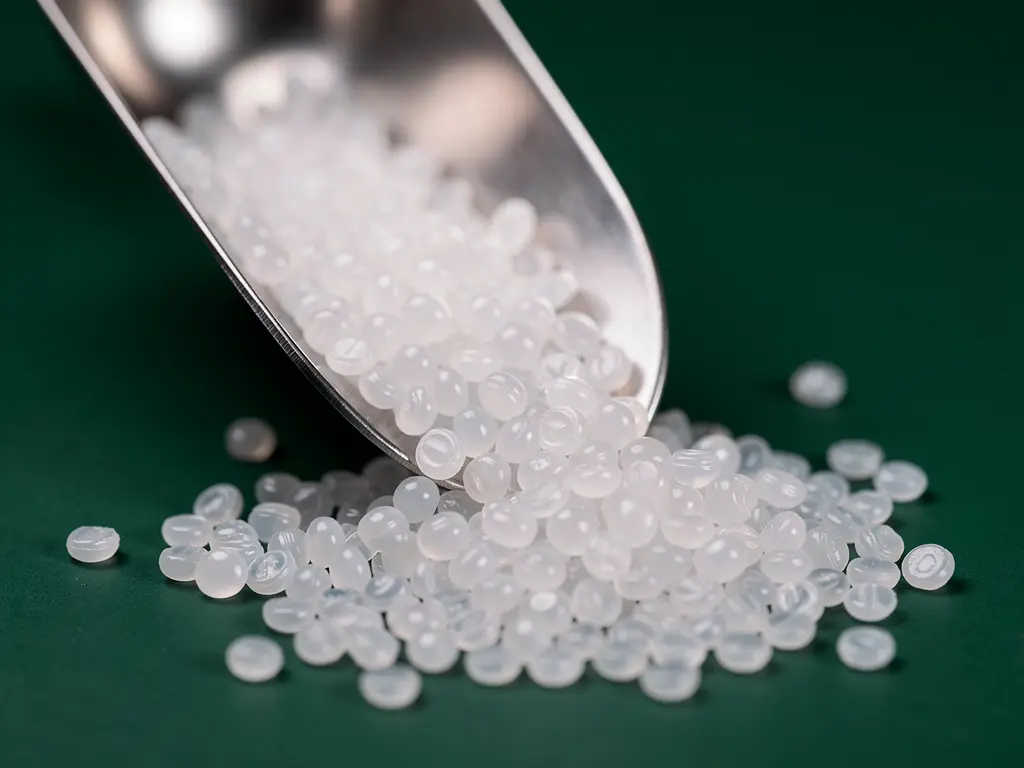
- LDPE stands for low-density polyethylene. It is a thermoplastic made by polymerising ethylene gas at high pressure.
- Density is roughly 0.910 to 0.925 g/cm³, melting point around 105 to 115 degrees Celsius.
- It is soft, flexible, tough at low temperature, chemically resistant, and it heat-seals easily. That last property is why flexible packaging runs on it.
- Its resin identification code is 4. Recyclable, reusable, and not biodegradable.
- The trade-off versus HDPE: LDPE is softer and easier to seal, HDPE is stiffer and stronger per unit weight.
Where the "low density" comes from
LDPE and HDPE are made from the same monomer, ethylene. The difference is the shape of the chains, and that shape comes from how they are made.
LDPE is produced at very high pressure, in the region of 1,000 to 3,000 atmospheres, in a process that causes the growing polymer chains to branch. Those branches stop the chains packing together neatly, so the solid has more empty space in it. Less mass in the same volume means lower density. HDPE is made at low pressure with catalysts that produce mostly straight chains, which pack tightly, giving higher density.
Almost everything else follows from that one structural fact:
- Branched chains slide past each other easily, so LDPE is soft and flexible where HDPE is stiff.
- Loose packing means fewer crystalline regions, so LDPE is clearer and HDPE is milky.
- Fewer crystals melt at a lower temperature, so LDPE melts around 105 to 115 degrees Celsius against roughly 120 to 130 for HDPE.
- Loose chains seal beautifully. Apply heat and pressure and the surfaces fuse. This is the single most commercially important property of LDPE.
LDPE at a glance
Two of those weaknesses have standard fixes. UV stabiliser masterbatch handles sunlight for outdoor products. LLDPE blending raises tear and puncture strength. Neither fixes the hot-fill limit, which is a hard property of the polymer.
Where you will find LDPE
Is LDPE safe? And is it recyclable?
Safety
LDPE contains no BPA and no plasticisers, and it is chemically stable at food-packaging temperatures. It is one of the standard food-contact plastics worldwide. In India, migration is governed by IS 9845, with IS 10146 covering polyethylene in food contact specifically. What makes a specific product food-safe is virgin resin plus a migration test on that material, which is why we insist on both for food-grade orders.
The real limit is heat. LDPE softens around 100 degrees Celsius. So freezing is fine, ambient is fine, boiling and microwaving are not.
Recyclability
LDPE is resin code 4 and it is genuinely recyclable. The honest caveat is that film is harder to recycle than bottles: it is light, it blows around, it tangles in sorting machinery, and it usually arrives contaminated with food or soil. So the material is recyclable while the system for collecting it is patchy. We will not tell you LDPE is biodegradable, because it is not. More in LDPE recycling.
Keep reading
LDPE basics, answered
Buying LDPE rather than just reading about it?
Send what you need to pack or protect. We will tell you whether LDPE is right, and if it is not, which material is. That advice is free either way.